The classroom is everything. It is the central learning environment of any school. It is the nucleus. Every part of the school, every decision that is made, every staff member in the building, every student and parent is concerned with making sure the environment in the classroom is set up for learning. All labor within a school works towards the fulfillment of a central goal: to mold responsible, educated, and imaginative people and give them the tools to discover the meaning in their lives. That goal (and that labor) should support what happens in the classroom.
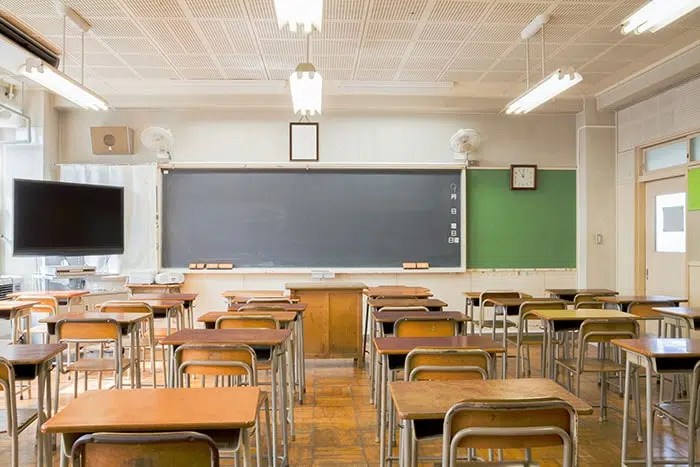
By no means does learning only happen in the classroom however. As educators know, many additional pieces fit into the broader puzzle of student learning. Field trips, guest speakers, workshops, school events, themed activities, holidays, student government, mentoring, and extracurricular activities all play their part in developing well-rounded students. Yet, as the old adage goes: time is money. Time is also learning. The additional tools just mentioned should be supplementary and should support learning in the classroom. If students are going to spend most of their school day in the classroom (whether they should or not is another topic of discussion) then the classroom is where most of the learning needs take place. Otherwise, what is the point of students and teachers spending their time there?
So how does the classroom become this house of learning? How can we build classrooms wherein students want to study, where they can prioritize leadership and mastery? There are countless ways, as is evidenced by the millions of teachers around the world each with their own style, working with their own set of challenges and within their particular context. Culture and context notwithstanding, all effective classrooms share a common set of features that undergird and support student learning. Classrooms must be a stable environment, so that all students have an opportunity to thrive. They must be a place where responsibilities are shared and roles are clear. The class must feel like a workshop, where master and apprentice explore concepts together.
Establishing a stable classroom environment is the number one goal for any educator. Without first creating this environment, positive relationships cannot be nurtured, expectations for behavior are not understood and followed, and a collective commitment to learning cannot be pursued. Depending on the context, establishing a stable environment is crucial when considering the lives of students. Many children come from broken families and broken homes. Some may be refugees or immigrants and come to the classroom without an adequate foothold in the broader culture. Some may come with learning, emotional or physical disabilities that can make traditional classroom instruction inaccessible. This is why the act of stabilizing the environment is necessary to create a classroom where learning is attainable for all students.
How is this stable environment created? First the physical space must be arranged in a way that promotes stability. Tables and chairs should be arranged in a clear layout. Whiteboards and chalkboards should also be organized into sections (one for announcements, one for questions, one for objectives, etc.) Cabinets and drawers should be labeled by their contents and those contents should not change. Any bulletin boards should be with marked student work or other items (artwork, quotes, maps, diagrams, charts) should have a clear place. If any of these parts of a traditional classroom are disordered or rearranged throughout the course of the lesson, they should be put back into their original places.
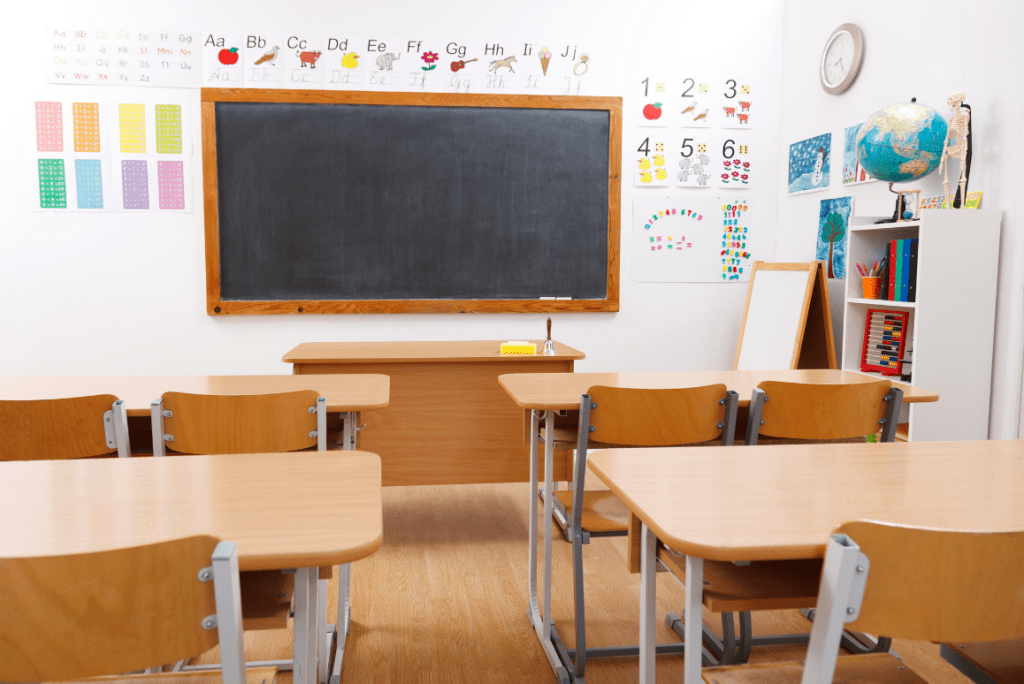
Why is physical organization important? In order to explore concepts and ideas students need to be creative and imaginative. Some might say that an intense focus on order impedes the natural process students use to make the classroom “theirs” and could thus stifle creativity. This is certainly true in some sense, but the deep and imaginative thinking that often lacks order, necessitates an orderly space to ensure that creativity is directed to the ultimate goals of the lesson and unit. Just as there is a “warm-up” within the lessons itself, there can also be a physical warm-up as students enter the room and are immediately sat in a space where deep thinking can occur.
Additionally, teachers should create a stable environment with expectations for behavior that are established both top-down and bottom-up. Top-down rules and regulations will come from the school itself and it’s behavior policies as well as the individual teacher. These policies (ideally) provide a structure for students to behave in a way that is conducive to learning, and to promote the behavior that is conducive to the broader community. Students also learn through socialization in the culture, and this point must be addressed, as the intersection between the culture of the school and community must coalesce around a shared set of predetermined norms of behavior. Especially in the context of international teaching, students and teachers often come from different, at times opposing cultures. This naturally leads to tension as expectations for behavior inside the school do not match expectations at home, and those differences manifest themselves in the classroom. In most instances, it is best for the teacher to adopt the style the kids are used to. If the students are used to democratically negotiating and creating “constitutions” where rules are discussed and agreed upon, the teacher is wise to take that similar approach. If students come from cultures that prioritize the collective over the individual than it is wise for the teacher to do the same. If students live in a culture that is authoritarian, then the teacher should be an extension of said culture.
Considering the above example, clearly the teacher cannot change their whole style to fit the culture. That is both unnecessary and perhaps not possible. To over-adapt the personality of the teacher to fit the culture is to forgo the individualistic qualities that make them a master. Yet to underadapt means that the teacher creates a crisis of communication and ignores the value that those cultural rules can have as tools for creating a stable environment. To over or under-adapt is to create an identity crisis within students and the teachers individually, but also a crisis within the class as a collective unit or team. The idea of “meeting people where they are” falls apart and chaos ensues (literally).
Teams have players and players have roles. As mentioned in a previous post, when one or more team members stray from the goal, the worst that can happen is a complete disintegration of the team structure. Another tool teachers can use to create a stable environment is by establishing roles and responsibilities. Culture is essential in determining the roles of individuals within family units and within society at-large. Yet cross-cutting all differences of background and culture is the natural order of hierarchy, place, and role. A biologist might say “niche.” When each member of the classroom accepts and understands their niche AND fulfills the duty associated with that niche, the classroom has taken another step towards a culture conducive to learning.

Contrary to the point that the teacher must be flexible in adapting to the cultural context of the students they teach, roles and responsiblities must be negotiated and agreed upon. Say students are grouped into tables/desks of four students each. The teacher could offer 4 different titles for students to choose from, or could even have students decide those titles beforehand. Let’s go with the former. The titles offered are “Organizer,” “Motivator,” “Worker” and “Thinker.” The teacher also gives a brief description of each role. The students have 2 tasks. First, they must agree that these are the 4 best titles for the 4 roles. Then they must either change the title to match the description or they must change the description to best match the title. Once each group has agreed upon the 4 roles and the description they can rename each title to represent the name of a figure from a shared interest. For example, a group of students who all love football could change the titles to names of famous players. Instead of “organizer,” “motivator,” worker” and “thinker,” there is a team with a “Vincent Kompany,” a “Carlos Puyol,” an “Ngolo Kante” and a “Pep Guardiola.” Because each group has agreed upon roughly the same titles and role responsibilities, when it comes time to work each micro-team is working in a similar way. As each micro-team follows similar rules that have been collectively negotiated and then properly calibrated for each group and individual, a macro-culture develops. Even without working with each classmate, all students are collaboratively fostering a stable culture and environment. There is also a sense of buy-in from students because they have personified obscure titles and responsiblities into people who they admire. This leads to a stronger sense of commitment and student engagement.
Most important to the creation of a stable environment in the classroom is the relationship between teacher and student. With any team or group working towards a common goal, there must be engagement from all members. Similar to the importance that roles and responsiblities plays in creating a stable environment, so to does the work itself. When people are pursuing work that is meaningful to them, they will work harder, longer, and be more resistant to challenges that arise. The same goes for students.
To ensure the classroom is a place where this meaningful work happens, curriculum must be taught in a way that allows students to explore things that interest them. A master and apprentice craftsmen elect to focus their time on one craft. Adults may bounce between different careers, yet are usually focused on one or two main disciplines at a time. This focus leads to specialization. This specialization means there are large gaps in general knowledge about the world. Everyone accepts the reality that you cannot be expert at several things. If this is reality, why do teachers run away from the fact that what students are learning is most likely not going to stick. If this harsh reality is true, why care if students leave history class knowing anything about Ancient Mesopotamia? Why care if they know or don’t know about the nitrogen cycle? Perhaps teachers could teach students without them acquiring the knowledge that is associated with it. Perhaps that is the skill-based, conceptual learning that will truly help students in their lives.

With this in mind the teacher should seek to maximize the “experiential learning” that is taking place. This is an essential challenge in the traditional classroom and is one of the main reasons why the supplemental tools mentioned in the introduction to this post are so popular amongst administrators, teacher, parents and students alike. Yet experiential learning is also the best form of teaching and is reflected most in the apprentice-workshop style classroom. In the workshop, an apprentice learns by watching the master work and by doing the work of the master. As the apprentice observes the master, they will inevitably notice the dedication, attention to detail, and care that is put into the work wherein the master finds their passion. Over time they will learn the nuances that the master understands implicitly, and the apprentice will refine their own work. Additionally, the apprentice realizes that while there is a reward when the work is complete, a true master finds motivation through the process of producing their work. It is the process, the experience of crafting their work that the master enjoys the most. When the teacher impresses this idea onto their students, the students can enter a state of flow and do the necessary deep thinking that is required for mastery. If students can enter this flow state on a consistent basis, then meaningful work can be produced. Experiential learning thus can act as another tool to provide stability within the classroom, as engaged learners avoid any distractions that may remove them from their craft.
The stable environment is the key to an effective learning environment. Without it, the positive relationships between students and teachers cannot form. The classroom becomes a physical manifestation of that lack of stability and becomes disarrayed. Skills and knowledge that students should care about are not learned. The teacher and students together respond to this and the classroom descends further into chaos. Yet with a space that is organized and primes students for learning the moment they walk into the room, a set of clearly defined roles and responsiblities so that learners’ have direction, and curriculum that is catered to student interests and allows the apprentice-master dynamic to flourish, a stable environment is created. Now that everything is set up to promote the highest quality of learning, class is in session.
 Tony Teaches